
Lee County City Directory Years
Fort Myers anchors the known printed run, but coverage reaches beyond the city. R.L. Polk editions begin in 1915-16. The 1927 Greater Fort Myers volume expressly includes Alva, Bay Shore, Bonita Springs, Buckingham, Estero, Olga, Owanita, and other communities. A person outside Fort Myers may therefore appear in a Fort Myers city directory.
| Collection | Years | Where held | Access |
|---|---|---|---|
| R.L. Polk Fort Myers | 1915-16; 1921 | FamilySearch catalog | Microfilm 2308581, items 1-2 |
| Fort Myers and Arcadia | 1923-26 | FamilySearch | Items 3-4 |
| Greater Fort Myers | 1927; 1935 | FamilySearch | Items 5-6 |
| Later runs | 1939, 1941, 1945, 1947, 1950, 1952-54, 1956-60 | Genealogy catalogs | Confirm exact volume |
| Telephone books | 1957-63 | Library of Congress | Cataloged collection |
The FamilySearch catalog identifies early items. Lee County Library has no current public volume-by-volume shelf list, so call before traveling for one year.
Lee County City Directory Genealogy Room
The Fort Myers Regional Library Genealogy Room, 2450 First Street, is the main local desk. It offers free extended appointments and FamilySearch Affiliate computers with some images unavailable at home. Ancestry Library Edition is in-library only. Fold3 and HeritageQuest add military records, census schedules, and thousands of family-history books. Call 239-479-4636. Hours are Monday through Wednesday 9 to 8, Thursday 9 to 6, and Friday and Saturday 9 to 5.
The county library page shows the service before a visit.
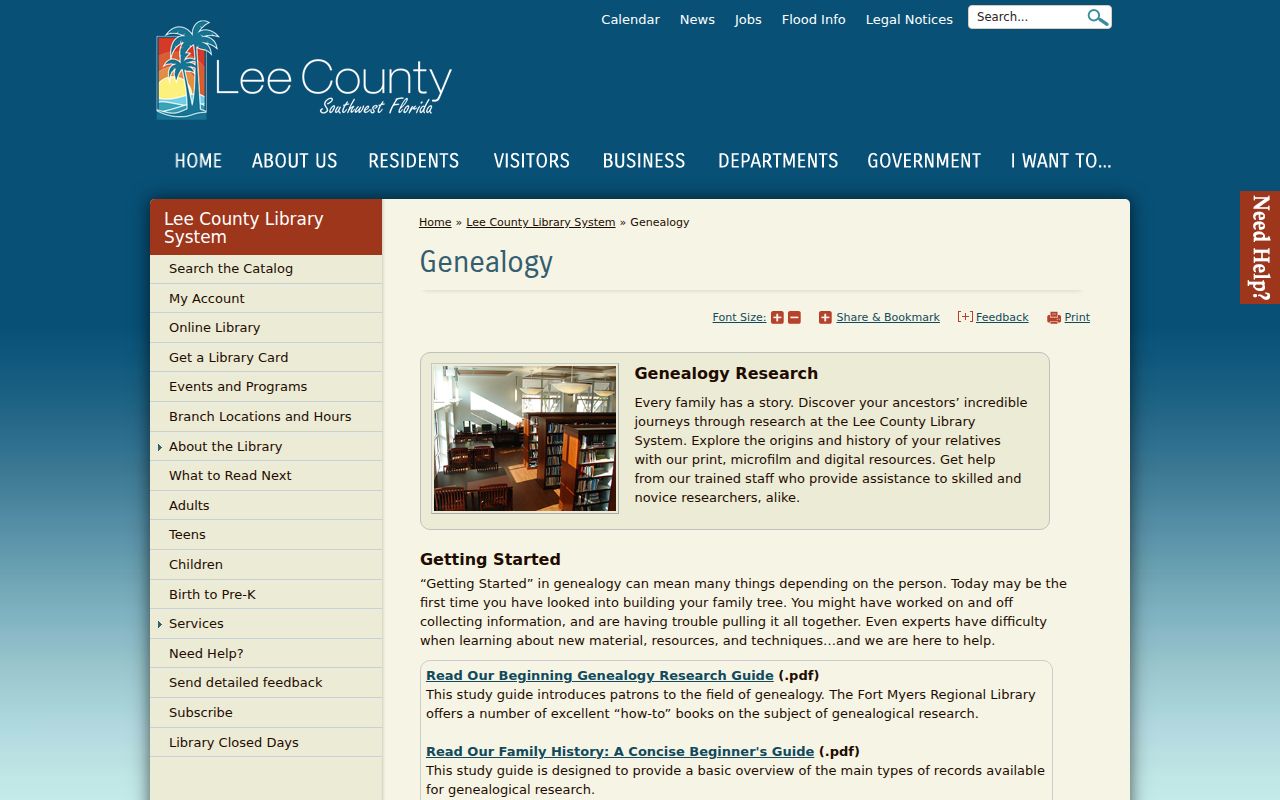
The branch combines staff help, microfilm readers, and restricted database access in one place.
Read Lee County City Directory Entries
A Polk line commonly gives a name, spouse, occupation or employer, and home address. Codes such as r, h, and wid matter. Photograph the abbreviation key in the same volume because meanings can change by publisher and year.
| Name | The indexed adult and printed initials |
|---|---|
| Spouse | Often in parentheses, not a full household roll |
| Occupation | Work and sometimes employer |
| Address | The residence reported for that edition |
| Widow mark | Often “wid” plus the deceased spouse |
- Criss-cross section
- A street and house-number arrangement.
- Householder index
- An address-order list of named adults.
- Abbreviation key
- The volume's legend for shortened terms.
Compare each entry with a census, deed, newspaper, or obituary before deciding that two similar names identify one person.
Lee County City Directory Companion Collections
The library's collection guide lists 10,630 print titles, more than 1,000 vertical-file items, and the Fort Myers News-Press on 1,151 microfilm rolls from 1884 forward. Its necrology index has more than 8,000 cards. The obituary research service accepts a name, death date, and city.
Florida's 1885, 1935, and 1945 state censuses help bridge missing directory years. Federal census schedules are public through 1950. A census can identify children and relatives omitted from a commercial directory. Interlibrary loan generally takes four to six weeks, so check whether the reel is already at Fort Myers Regional or Cape Coral-Lee County Library.
Changed Streets in a Lee County City Directory
FGCU oral history identifies Garret Street as modern Broadway and Anderson Avenue as Martin Luther King Jr. Boulevard. Search both forms in city directories and newspapers. When a name bridge remains uncertain, use lot, block, plat, or legal description. Those identifiers are more stable than street wording.
The Tamiami Trail bridge arrived in 1924, the Trail opened in 1928, and large postwar plats changed Lee County. A failed historical address search may reflect growth or renaming. Modern address work belongs in the Lee County street directory.
Lee County City Directory and Original Record Books
The Clerk Historical Document Library at 2115 Second Street holds more than 150 original volumes. General Indexes and plats begin in 1887; marriage licenses begin in 1888. The shelves also contain tax-deed records and Marks and Brands Record 2 from 1899. These sources can identify rural residents missed by urban publications.
Fragile books cannot be photocopied, but cameras and handheld scanners are permitted. Use a marriage index, plat, or General Index to distinguish same-name people and connect an old address with a legal description.
Florida City Directory Shelves
The State Library city-directory collection spans the early 1900s to the present overall and is arranged by city, then year, for on-site use. It is a fallback when a Fort Myers edition is absent locally.
The official collection page appears below.
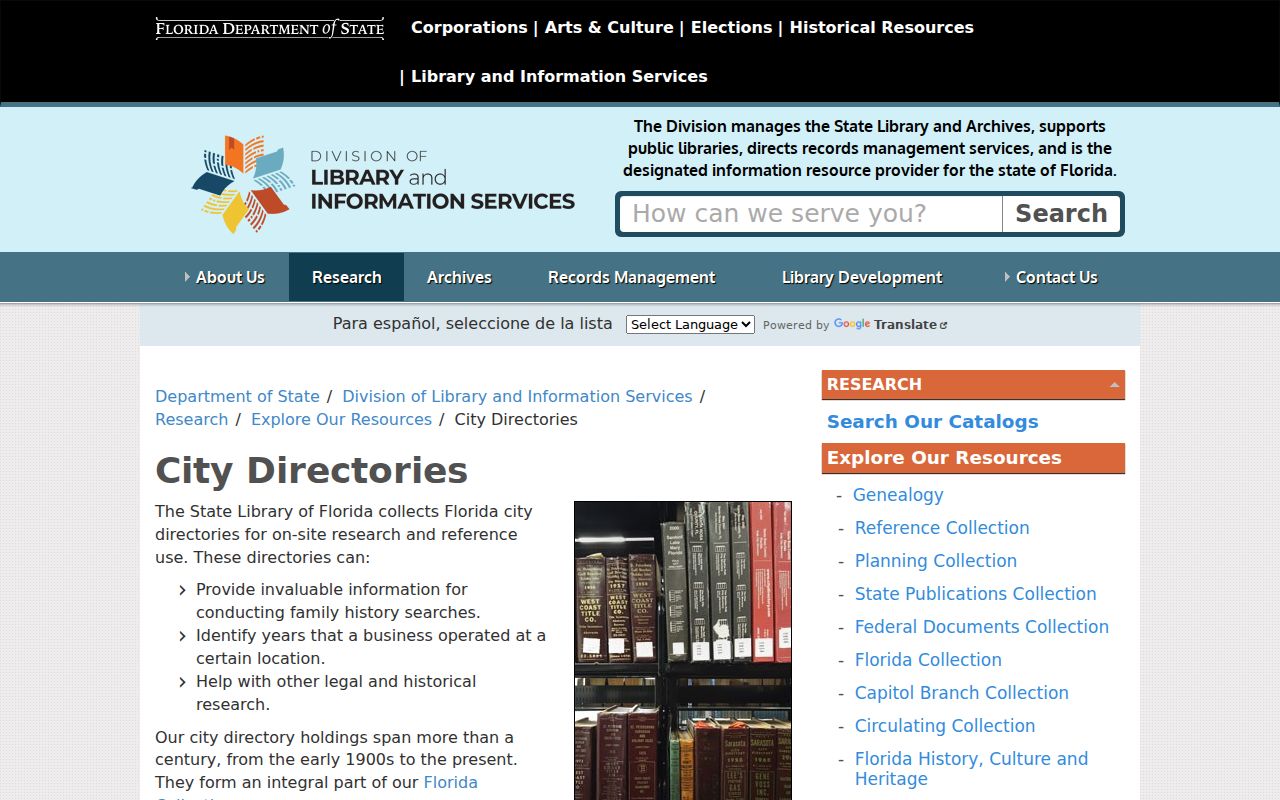
The statewide span does not promise an uninterrupted Lee County run. Verify the exact city and year first. Fort Myers Sanborn map coverage is confirmed for 1908 at the Library of Congress, but no extra years should be assumed.
Lee County Directory Access Paths
Not every useful volume is fully open on the web. Start with the FamilySearch catalog to identify the microfilm item and publication year. If an image is restricted, use a computer at the FamilySearch Affiliate branch in Fort Myers. The same visit can include newspaper film, the necrology index, vertical files, census material, and staff help. Telephone Reference at 239-479-4636 is the practical first step when travel is difficult.
For a State Library volume, consult its official city-directories page and confirm the Fort Myers year before visiting. The Clerk's Historical Document Library is a separate counter for original indexes, marriage books, plats, and rare volumes. Cameras and handheld scanners make that room useful when copying is barred. A county administration request does not replace a direct library or Clerk inquiry.
When no directory survives for the target year, bridge the gap with sources on both sides. A Florida or federal census can establish a household. Newspaper microfilm may place the family between schedules. A marriage entry, deed, or tax record can confirm names and geography. Keep the publication date beside every fact because an address reflects one edition, not an undated period.
Trace Lee County Families
Follow a person across several editions. This catches moves, marriages, deaths, and spelling shifts while avoiding the mistake of treating one printed line as final proof.
- Search the nearest known year using surname, initials, and variants.
- Record the entry, page, and abbreviation key.
- Move earlier and later, noting each spouse and address change.
- Check any street-order section for nearby households.
- Pair directory years with state and federal census schedules.
- Confirm the trail with an obituary, deed, marriage record, or newspaper.
Lee County was created from Monroe County on May 13, 1887. Earlier residents may be indexed under Monroe. A missing city-directory line can also mean a skipped year, move, death, omission, or alternate spelling. For a present-day check, use the Lee County resident lookup and keep current evidence separate from the historical trail.
Verify Lee County Directory Clues
A printed address becomes stronger when it agrees with a second record from the same period. Lee Clerk Official Records reaches back to 1887 and can connect a named owner with a deed, mortgage, plat, or marriage license. Search the surname with a first initial, widen the date range, and remember that the portal begins with a 2010 default date unless reset. An index result is only the start. Read the recorded image for the parties and legal description.
The property and deed trail answers a different question from a city directory. A deed identifies ownership. A directory can associate a person with a home in its publication year. Neither source lists every household member. Pair both with the 1935 or 1945 Florida census, a federal census through 1950, or library newspaper film when distinguishing occupants from owners.
Original records have several access paths. Public Clerk images can be viewed online when legally available. Researchers may also use the Official Records kiosk at 2115 Second Street, request copies from the Clerk, or inspect historical books in the second-floor library. A rare volume may allow photography when photocopying is barred. Record the book, page, instrument, volume title, image number, and access date so another researcher can retrace the conclusion.
Absence requires restraint. A missing name may reflect an unlisted household, skipped year, unavailable pages, spelling variant, move between canvass and publication, or coverage that did not reach the community. Before 1887, search Monroe County as the predecessor jurisdiction. For later rural families, add plats, tax-deed books, marks-and-brands records, and newspapers instead of forcing an urban directory beyond its reach.