
Find a Lee County Resident from One Known Detail
Start with the detail that can be checked most cleanly. A street address belongs in the Lee County Property Appraiser search; a name can be tested there and in the Clerk's Official Records index; a court case belongs in Court Records Inquiry. A historical name may be easier to find in a Polk directory, census schedule, obituary index, or newspaper than in a current roll.
Keep the source's limits in view. A parcel card names an owner, not everyone at the home. A voter entry concerns a registered voter and never reveals a ballot choice. A docket address may be an address used for service or filing. The Lee County residents directory works best as a route to dated evidence, not as a claim that every person at an address has been found.
If only a phone number is known, first preserve its full area code and the date it was observed. A reverse result can suggest a name or place, but it needs confirmation in an official source. If the name is tied to a company, search Florida's Sunbiz index for officers, registered agents, fictitious names, and filing documents, then compare the filing date and address with a county parcel or recorded instrument. Florida's DBPR and health-practitioner searches can verify a regulated license by name and status. A business or license address may be an office or mailing point, so neither one proves a home.
For family research, begin at the other end of the time line. An obituary, yearbook, marriage entry, or city directory can establish a date and spelling that makes later searches more precise. Probate dockets and estate deeds may identify a personal representative or heir, while Florida's official adoption and reunion procedures are the lawful route for a birth-parent search. Write down the exact source title, year, page, and access date. That small research log helps separate a verified Lee County resident from another person with the same name.
- Search the Lee County Property Appraiser by owner name or address and note the roll year, situs address, mailing address, STRAP, and deed reference.
- Use the Lee Elections voter tools when voter status is relevant, while allowing for nonregistration, monthly updates, and protected addresses.
- Follow the instrument number or book and page into the Clerk's Official Records index, then read the recorded image rather than relying only on the result row.
- For an older household, use Fort Myers Regional Library's city directories, census film, newspapers, and necrology index.
- Ask the office that created the record when the portal is incomplete; chapter 119 provides the request framework for nonexempt Florida records.
The Offices Behind Lee County Resident Records
Lee County has separate custodians for separate facts. The Property Appraiser maintains assessment and parcel data. The Clerk records deeds, mortgages, liens, plats, judgments, and marriage licenses and keeps county and circuit court files. Lee Elections maintains voter information, while Florida Health in Lee County handles local birth and death certificate service. A general county request is not a substitute for a request to one of these constitutional offices.
The Clerk's Official Records service and its Court Records Inquiry are also separate paths within the same office. Recorded land instruments are searched by indexed party, document type, date, instrument number, or book and page. Court cases are searched by case number, citation, party, division, and filing details. A request for a certified deed should therefore not be sent as a court-file request. Likewise, a county NextRequest submission does not replace a voter-data order to Lee Elections or a parcel-data question to the Property Appraiser.
Vital records require another distinction. Florida Health in Lee County serves local birth and death certificate customers, while the state Bureau handles Florida certificates and certifications across counties. The Lee Clerk holds the actual local marriage license and divorce case material. A state marriage or divorce certification may confirm the event, but it contains less than the county instrument or final judgment. Ask for the product that answers the question, since eligibility, identification, redaction, fees, and processing time depend on that choice.
Lee County Property Appraiser
Countywide parcel and assessment roll
Owner, address, STRAP and deed fields
Lee County Supervisor of Elections
Registered-voter services and data orders
Protected fields remain exempt
Search the Lee County Property Roll by Name or Place
The Property Appraiser offers the broadest starting point for a current address. Its free public search accepts a person or company name and several forms of property detail. The result can join a spelling to a parcel, show whether the owner mailing address differs from the site, and supply the recorded-deed reference needed for the next step.
| Search route | Useful entry | What to capture |
|---|---|---|
| Owner | Owner or company name | Displayed owner, mailing address, roll year |
| Location | Street address or postal code | Situs address, municipality, site ZIP |
| Parcel | STRAP or Folio ID | Stable parcel identity and legal description |
| Deed | Instrument number or book/page | Sale reference leading to Official Records |
| Legal text | Subdivision, lot, block, grantor or grantee | Alternate route when an address has changed |
The official Lee Property Data Search is shown below. The successful manifest capture documents the same owner and address search surface described in the research.
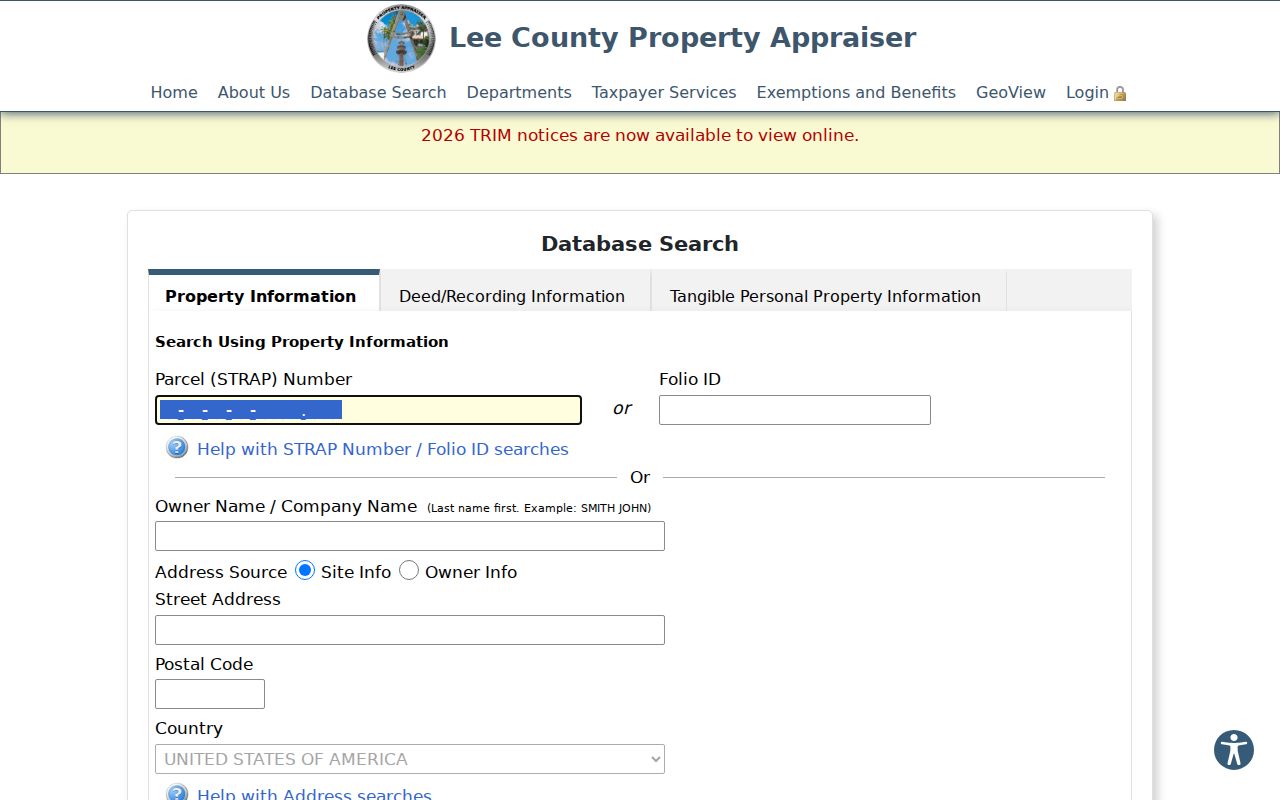
Use the parcel result as an index into other records. It should not be treated as proof that every owner lives at the site or that all occupants are named.
The Address Source control is especially useful in Lee County because it separates Site Info from Owner Info. Site Info searches the physical parcel address and site postal code. Owner Info searches the address used for tax correspondence. That difference matters for seasonal owners, trusts, companies, island property, and mail sent outside Florida. Compare the two fields rather than assuming a mismatch is an error. A homestead exemption can support owner occupancy for a roll year, yet it remains evidence about an owner and exemption, not a list of spouses, relatives, renters, or other household members.
Once a parcel is open, record the roll year, STRAP, Folio ID, abbreviated legal description, current and prior STRAP values, deed instrument, sale history, exemptions, land use, and building facts. GeoView can then place it among adjoining parcels and display current or historical aerial layers, zoning, and sales context. The map is useful for orientation but is not a legal survey. A recorded plat and legal description remain the stronger sources when a boundary, lot sequence, or renamed street creates doubt.
Parcel: a mapped unit of land with a stable county identifier. Roll: a dated assessment list. Index: a finding aid that points to a document. Criss-cross directory: a volume arranged by street address rather than only by surname.
Carry a Lee County Name into Recorded Documents
The Clerk says its searchable Official Records reach back to 1887, the year Lee County was created from Monroe County. Searches cover parties to deeds, mortgages, liens, plats, judgments, marriage licenses, and other recorded instruments. The index is free where records are public, and many images can be viewed online. Certified or e-certified copies are separate products.
Search a surname with a first initial, try former names and suffixes, and widen the date range. The Landmark search may begin at January 1, 2010, so an older deed search can fail simply because the default was never reset. Read the image after finding a hit: the index row helps locate it, while the instrument itself identifies the operative parties and legal description.
For an ownership trail, begin with the newest purchase instrument shown on the parcel card. Open that deed and identify the seller, who is normally indexed as grantor. Search that seller as a prior grantee to locate the acquisition deed, then repeat the same move backward. Keep instrument numbers, recording dates, consideration if shown, and the legal description in a table. The recurring lot, block, subdivision, or metes-and-bounds description is often more stable than the street text. Mortgages and satisfactions may add dates and name forms, but a deed chain proves ownership transfers, not every person who occupied the property.
Online Official Records reach the county's creation in 1887. Earlier Lee-area work may lead to Monroe County, state land files, or federal sources. The Clerk's original General Indexes and Historical Document Library are valuable when a web image is missing or an old handwriting-based index needs direct inspection. Free web viewing may answer an informal question. A certified copy is needed only when an agency, court, or other recipient requires certification, and it should be ordered through the Clerk rather than an official-looking private solicitation.
Use Lee County resident records only for lawful personal research. Never use an address trail to stalk, harass, intimidate, or harm someone.
Compare Current Lee County Resident Directory Sources
No current source lists every household. Each official roll describes a defined relationship: ownership, registration, a recorded transaction, or a court filing. Choosing the source by that relationship reduces same-name mistakes and makes omissions easier to explain.
| Source | Who It Lists | Keeper | Access |
|---|---|---|---|
| Property assessment roll | Parcel owners | Lee Property Appraiser | Free public portal |
| Voter information | Registered voters, subject to exemptions | Lee Elections | Personal lookup or data order |
| Official Records index | Parties to recorded instruments | Lee County Clerk | Free public index and many images |
| Court Records Inquiry | Parties in public county and circuit cases | Lee County Clerk | Free search; access varies by user level |
| Professional and business indexes | Licensees, officers and registered agents | Florida DBPR, MQA and Sunbiz | Free state portals |
A commercial search tool may blend stale or unexplained data, while an official index identifies the custodian and record date. Official does not mean complete, but it gives a document that can be checked and corrected through the right office. For one-name verification, use the focused Lee County resident lookup workflow.
Free and paid access also describe the product, not its truth. The Lee property search, Official Records index, many recorded images, CRI search, Sunbiz filings, state license lookups, and Florida Treasure Hunt name search can be used without an ordinary search fee. Certification, mailed copies, some voter-data products, and federal PACER use can carry charges. Pay only when the copy or access level is needed. Capture the index details first so the office can identify the exact document and avoid a broad, costly request.
Florida Treasure Hunt offers another official name index for unclaimed property. A match can preserve an older mailing address or owner name, but the state claim process requires proof and should be started only through the official portal. Sunbiz records can connect a person with a corporation, limited liability company, or fictitious name, while DBPR and MQA can corroborate a professional identity. These sources describe a filing, property, or license relationship. Compare dates and do not silently turn any business address into a claimed residence.
Read Lee County Voter Information with Care
Florida voter records can confirm a registered voter's declared residence and status at the time of the file. Lee Elections also documents geographic data products, including precinct and district extracts, through its order process. A voter file does not list children, nonvoters, or every adult at an address, and participation history never discloses how anyone voted.
The county lookup is designed for an individual checking voter information. Larger research questions use the documented data-order route. Available products can be organized by county, precinct, district, or other geographic selection, with CSV pricing that varies from no charge to $75 depending on the product. Tailor the order to the smallest useful area and ask Lee Elections about the current production method. A geographic extract may show registered-voter presence near an address, but it should never be published as if it were a complete Lee County residents directory.
Social Security, driver-license, and state-ID numbers are exempt. Signatures may be viewed but not copied under Florida Statute section 97.0585. The Attorney General's Address Confidentiality Program and exemptions for specified personnel can hide address information. An absent hit therefore supports no broad conclusion about residence.
The Lee County Elections site provides the official entry to voter tools.
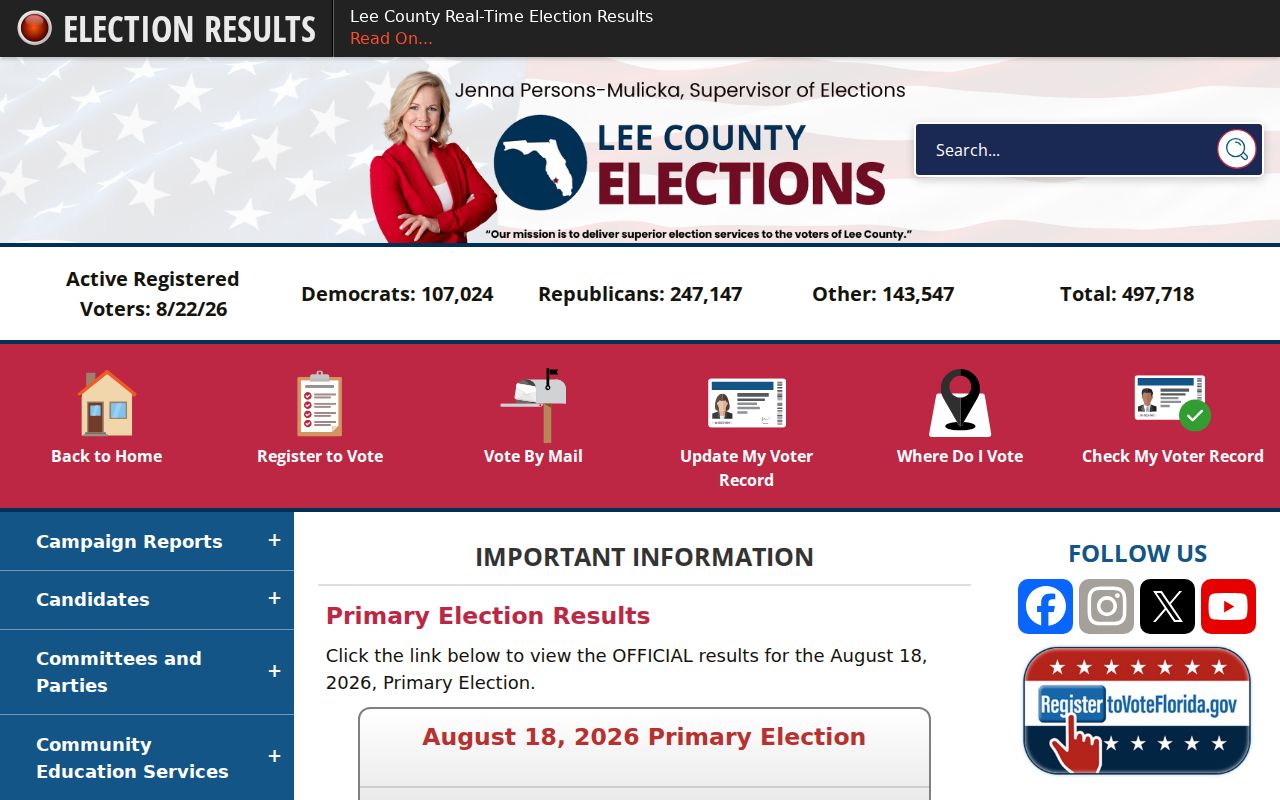
This captured page is a doorway to Elections services, not a countywide roster that should be copied or republished.
Voter data is updated on a schedule, so save the file date. A recent move, new registration, inactive status, or pending update can explain a conflict with a parcel card. Voting history means only that an election participation event was recorded; the secret ballot prevents the file from revealing a candidate or choice. If an address is protected, do not attempt to defeat that protection by combining other sources. Send a correction or confidentiality question directly to Lee Elections.
Verify a Lee County Resident Across Two Records
Common names, compound surnames, initials, former names, and business punctuation can split one person among several indexes. Lee County's large seasonal population also makes an owner mailing address and a local site address a poor match at times. Record dates matter as much as spelling.
Choose one dated record with a name and address, such as a parcel card or deed.
Try surname-first order, initials, suffixes, former names, and CRI wildcards.
Match a second independent fact, such as a parcel identifier, instrument, docket date, or license number.
Explain any date or address conflict instead of merging two people into one.
A failed search may mean a protected, sealed, purged, older, misspelled, or not-yet-updated record. It is not evidence that a person never lived in Lee County.
Use an identity worksheet when the name is common. Put each source on its own row with the exact indexed name, record date, address type, identifying number, and custodian. Middle initials, suffixes, spouse names, a repeated legal description, or the same business entity can strengthen a match. Conflicting ages, dates, or distant addresses should remain visible rather than being averaged away. The strongest conclusion states what each source actually shows, such as ownership on a dated tax roll or a party role in a recorded deed.
Lee County's growth and mix of long-term, seasonal, and newer residents make date checks essential. Population expanded greatly as Cape Coral, Lehigh Acres, Estero, Bonita Springs, and other large developments grew. A printed directory belongs to one publication year, a voter extract has an update cycle, a deed reflects a transaction and recording date, and a parcel card belongs to an assessment roll. When two addresses differ, first ask whether the records describe different dates or different address types before deciding that one is wrong.
Use Lee County Court Files as a Separate Index
Lee County Court Records Inquiry searches circuit and county cases by case number, citation, party, and court category. Public access follows the Florida Supreme Court security matrix. Registered access can expose more business-name and document functions, while confidential divisions and sealed material remain restricted. Broad searches can also meet a 500-result cap.
A docket result can supply a case number, party spelling, filing date, case type, and event list. It does not necessarily prove a current home address. Narrow by division and date, use the supported wildcard method for name variants, then inspect the docket or request the permitted document from the Clerk. Federal cases from Lee County instead run through the Middle District of Florida and PACER, where access charges may apply.
CRI's public result may show the case number, parties, court division, filing status, docket events, and document availability. Some documents require registration or a different access level, and family, juvenile, sealed, or confidential material may be unavailable. A search that reaches the 500-result cap should be narrowed by date or court category. If an expected case does not appear, use the Clerk's request channel with the known names, approximate date, and case type rather than concluding no case exists.
Florida appellate cases use the separate ACIS search, while federal trial cases for Lee County are filed in the Middle District of Florida. These systems have their own coverage, access rules, and identifiers. An arrest-search result is also distinct from a court disposition, and an arrest is not a conviction. Keep the agency, event date, and case number attached to every note so data from criminal custody, county court, appellate court, and federal court is not blended into one unsupported history.
Choose the Right Lee County Vital Record Product
Florida Health in Lee County offers local birth and death certificate service, while the state Bureau of Vital Statistics handles statewide certifications. Births under 125 years old are confidential except to eligible applicants. A death certificate without cause is available to adults, but cause-of-death and medical portions stay confidential for 50 years, and Social Security numbers remain protected.
Marriage licenses recorded by the Lee Clerk date to 1888. State marriage and divorce certifications begin June 6, 1927, but an abstract is not the same as the county license or final divorce judgment. Recent events can take about 60 days to reach the state, so the Clerk may be the more direct custodian for a Lee event.
Local birth service covers Florida births from 1930 forward, while the state notes limited earlier births and statewide registration from 1917. Eligible applicants for a confidential birth must document identity and relationship. Death service has a different rule: an adult can order a certification without cause, but access to cause within 50 years is limited to specified relatives, representatives, documented estate interests, or a court order. The applicant should choose the correct certificate type instead of requesting protected details that are not needed.
Applications depend on exact event facts. A birth request asks for the registrant's name, sex, date or year range, place, and parents' full premarriage names, plus applicant identity and eligibility. A marriage request uses both spouses' premarriage names, dates of birth, event date or range, place, and licensing county. A death request can use the decedent's name, dates, place, and relationship evidence. Older photocopies can take longer than the usual three-to-five-business-day state computer-record processing.
The Florida vital certificate portal shows the state application routes.
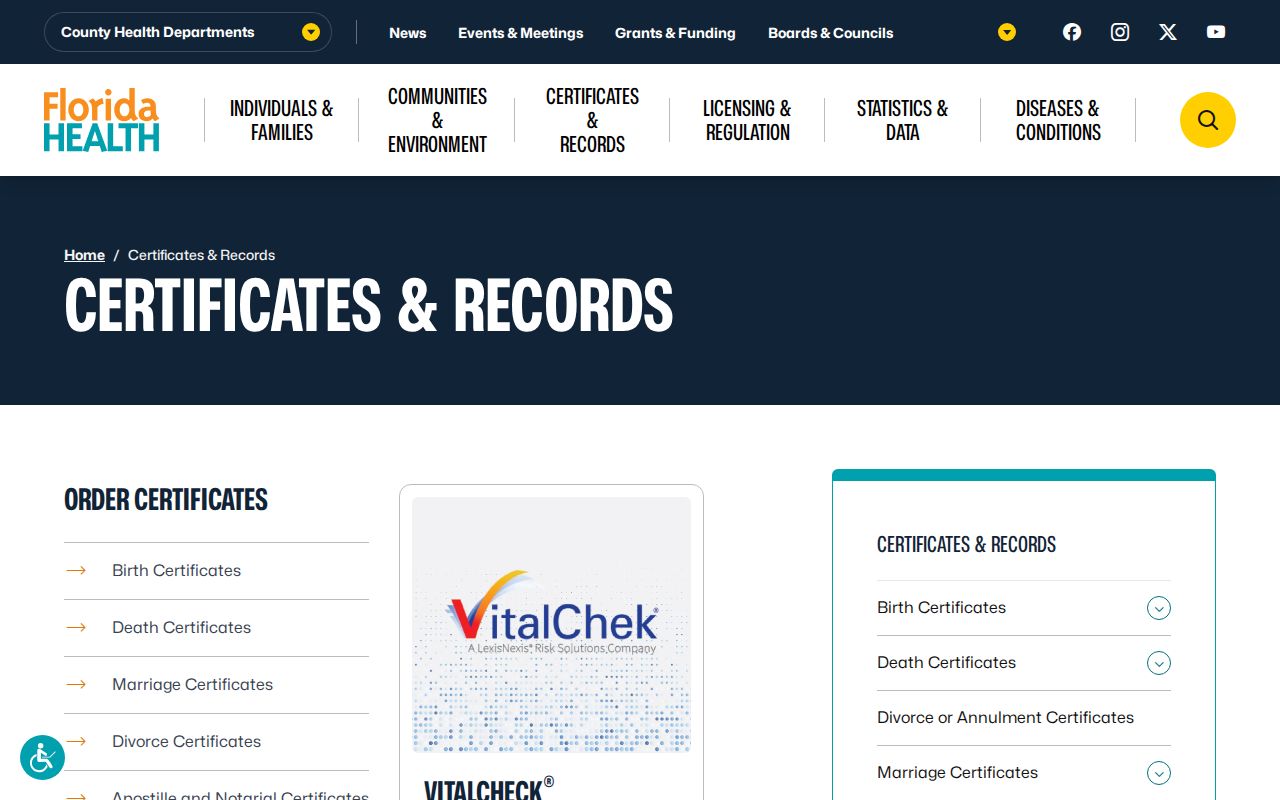
The certificate type, eligibility, identification, and fee should be checked before ordering because fees are nonrefundable.
Follow Lee County Records Beyond the Web Portal
Online access is only one channel. The Clerk offers viewing, online copies, counter service, mail requests, and certification routes for its records. Historical Document Library books may be inspected on the second floor at 2115 Second Street; fragile volumes cannot be photocopied, but personal cameras and handheld scanners are allowed. Property questions belong with the Property Appraiser, and voter-data requests belong with Lee Elections.
For county-department records, Lee County moved new requests from GovQA to NextRequest on May 1, 2026. Older GovQA matters remain trackable. The Public Records Request Center custodian can also be reached at 2115 Second Street, Fort Myers, by PRRCustodian@leegov.com or 239-533-8735. Florida Public Records Law does not require a stated purpose or special form, though lawful duplication and extensive-use charges may apply.
The Lee County public-record request page explains the current route.
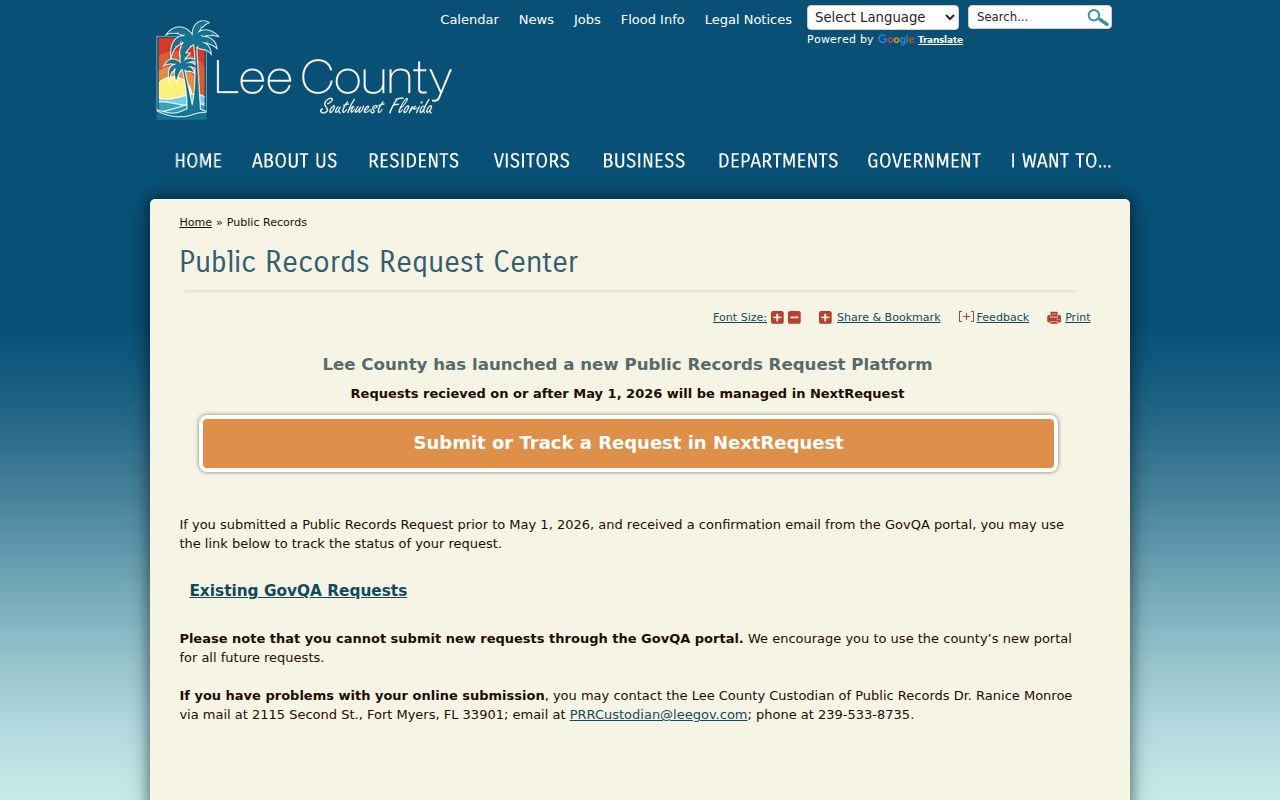
This county portal does not replace the Clerk, Property Appraiser, Elections, or other independent custodians.
Florida's constitutional access right appears in article I, section 24, and chapter 119 supplies the main statutory procedure. A requester generally does not have to explain why a nonexempt public record is wanted or use the agency's preferred form. An office may still ask for enough detail to locate the material and may assess charges authorized for duplication or extensive staff and technology use. A narrow request names the department, record type, date range, address or parcel, and preferred electronic format without asking the custodian to conduct open-ended research.
When a responsive portion is exempt, the custodian should apply the controlling rule and release any nonexempt remainder as required. Protected-address requests are office-specific, so a redaction handled by Elections may not automatically reach the Property Appraiser, Clerk, or another database. The Address Confidentiality Program provides qualifying victims with a substitute address and mail agent. Specified personnel may have additional protection under section 119.071. These safeguards explain why a responsible Lee County residents directory search accepts some gaps.
Match Lee County Residents to the Correct Municipality
Countywide records and city records answer different questions. Deeds, assessment parcels, county and circuit court files, and Lee Elections data cross municipal lines. Permit, code, police, and local administrative records may instead belong to Fort Myers, Cape Coral, Bonita Springs, Sanibel, Fort Myers Beach, Estero, or a Lee County department for an unincorporated address. The mailing city alone does not settle that jurisdiction.
This distinction matters around San Carlos Park, Iona, Gateway, and Florida Gulf Coast University, where a Fort Myers postal label can describe a place outside Fort Myers city limits. Island and rural addresses add similar ambiguity. Check the site address in county GIS or the Resident Information Tool before sending a request. Those tools can identify municipality, commissioner and school districts, utilities, emergency-service geography, and nearby public facilities, but the displayed map remains informational rather than a legal survey.
For permits or code records in unincorporated Lee County, Development Services accepts public-record inquiries online and in person at 1500 Monroe Street. A Cape Coral or Fort Myers project belongs with that city's custodian instead. Correct routing prevents a false "no record" response that only means the wrong office was searched.
The postal layer creates another common error. ZIP boundaries describe mail delivery, not city limits, taxing authority, or emergency-service jurisdiction. A parcel may have a Fort Myers mailing city while lying in Iona, Gateway, San Carlos Park, or another unincorporated community. Verify the delivery ZIP through the official USPS address lookup, then use Lee GIS for the government geography. The parcel's site ZIP, the owner's mailing ZIP, and a legal description each answer a different question and should remain separate in research notes.
Lee County's physical variety makes that discipline useful. Cape Coral's extensive street grid, platted Lehigh Acres, Sanibel and Captiva, Pine Island, Boca Grande, Estero, Bonita Springs, and rural Alva do not share one simple address pattern. E911 Addressing coordinates names and numbering in unincorporated Lee and corrects duplicates, sequence errors, odd-and-even problems, and outdated rural-box numbers. If a modern street search fails, use the STRAP, Folio, lot and block, or recorded plat before assuming the parcel or resident record is absent.
Open the Historical Lee County Residents Directory Shelf
Fort Myers directories begin with R.L. Polk's 1915-16 volume, followed by runs for 1921, 1923-24, 1925-26, 1927, and 1935. Later cataloged years include 1939, 1941, 1945, 1947, 1950, 1952-54, and 1956-60. The 1927 Greater Fort Myers volume reaches beyond town to communities such as Alva, Bonita Springs, Buckingham, Estero, and Olga. Telephone-book runs from 1957 through 1963 offer another bridge.
Fort Myers Regional Library's second-floor Genealogy Room offers specialist appointments, FamilySearch Affiliate access, newspapers on microfilm from 1884 forward, a News-Press necrology index, and more than 1,000 vertical-file items. Polk entries may identify a spouse, occupation or employer, home address, and abbreviations such as r, h, or wid. The full Lee County city directory guide explains the volumes and their abbreviation keys.
Lee County itself began in 1887. For an earlier resident, check predecessor Monroe County records rather than assuming the local trail was lost. The Clerk's Historical Document Library adds more than 150 original volumes, including general indexes, plats, marriage books, and the unusual Marks and Brands Record 2 from 1899.
Trace a household across adjacent directory years rather than reading one entry alone. Begin with the surname section, copy the spouse, occupation, employer, and home address exactly, then check the abbreviation key for that volume. If a reverse or street section exists, inspect nearby numbers and both sides of the block. Pair the 1915 through 1927 entries with available federal censuses, and compare the 1935 and 1945 directory years with Florida's state census schedules. A disappearance may mark a move, death, publication gap, changed spelling, or simple omission.
Newspaper and obituary sources can close that gap. The library keeps News-Press microfilm from 1884 forward and accepts obituary requests supported by a name, death date, and city. Its necrology index and vertical files can lead to relatives, civic groups, businesses, or a later address. FGCU Archives and Special Collections adds Southwest Florida and Koreshan material, while Florida Memory and the State Archives provide maps, photographs, newspapers, and government collections. These sources give context, but any present-day contact conclusion still needs current evidence.